What Is A HIFU Facelift? What To Expect During Treatment
Oct 17, 2026
A firmer jawline, smoother skin, and a more defined facial contour are common goals for people who want to reduce visible signs of aging without undergoing surgery. A HIFU facelift is one non-surgical option designed to improve skin firmness and provide a subtle lifting effect. It uses focused ultrasound energy to heat targeted tissue beneath the skin while leaving the surface largely intact.
HIFU has become a popular treatment option in aesthetic clinics and medical spas because it does not require surgical incisions and typically involves little downtime.
What Is a HIFU Facelift?
HIFU stands for High-Intensity Focused Ultrasound. A HIFU facelift is a non-surgical aesthetic procedure that uses concentrated ultrasound energy to target specific depths beneath the skin. The resulting heat stimulates tissue responses associated with collagen remodeling, which may help improve skin firmness over time.
Unlike a traditional surgical facelift, HIFU does not involve removing excess skin or surgically repositioning facial tissues. Instead, it aims to produce a gradual lifting and tightening effect.
Depending on the device and treatment protocol, HIFU may be used on areas such as:
The cheeks and lower face
The jawline and jowls
The area beneath the chin
The forehead and brow area
The neck
Selected areas with mild to moderate skin laxity
Not every device is cleared or intended for every treatment area. Treatment suitability depends on the equipment, the practitioner's training, and the individual's skin condition.
How Does HIFU Facelift Treatment Work?
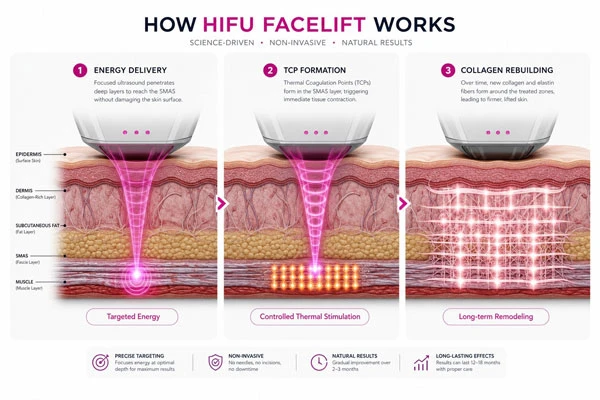
HIFU delivers focused ultrasound energy to selected tissue depths. This energy creates controlled thermal points beneath the skin, triggering a localized tissue response that can support collagen remodeling.
Collagen is a structural protein that helps keep skin firm and resilient. As people age, collagen production and skin elasticity decline, which can contribute to loose skin, less-defined facial contours, and the appearance of jowls.
HIFU treatment is intended to address some of these changes without creating a large wound on the skin's surface.
The treatment process generally involves three stages.
1. Focused ultrasound energy delivery
The practitioner applies a treatment handpiece to the skin and delivers ultrasound energy to the selected tissue depth. Depending on the device, different transducers or cartridges may target different layers.
2. Controlled thermal stimulation
The focused energy creates small areas of thermal stimulation in the targeted tissue. Proper energy selection and treatment technique are important for balancing treatment goals with safety.
3. Gradual collagen remodeling
Following treatment, the body's tissue response develops over time. Improvements in firmness may become more noticeable over several weeks to a few months rather than immediately after the procedure.
The degree of lifting depends on several factors, including the patient's age, baseline skin laxity, anatomy, treatment settings, and individual response.
What to Expect During a HIFU Facelift Treatment
If you are considering HIFU for the first time, understanding the treatment process can help you feel more prepared.
Step 1: Consultation and Skin Assessment
Before treatment, a qualified practitioner should assess your skin condition, facial anatomy, medical history, and aesthetic goals.
This consultation helps determine whether HIFU is appropriate and which areas may benefit most. People with significant excess skin may be better suited to other treatment options, including surgical procedures.
The practitioner should also explain the expected results, possible side effects, limitations, and available alternatives.
Step 2: Cleansing and Preparation
The treatment area is cleaned to remove makeup, oil, and other residue. Depending on the device and protocol, ultrasound gel may be applied to improve contact between the handpiece and the skin.
The practitioner may mark specific facial areas to guide treatment placement. Protective measures should be used as required by the device instructions.
Step 3: Selecting the Treatment Depth and Settings
HIFU devices may offer different transducer depths and energy settings. The practitioner selects suitable settings according to the treatment area, tissue characteristics, and the manufacturer's instructions.
For example, treatment around the jawline may require a different approach from treatment around the cheeks or forehead.
More energy or more treatment lines do not automatically mean better results. Incorrect settings or placement may increase the risk of burns, nerve injury, or unwanted changes in facial fat.
Step 4: Delivering Ultrasound Energy
The practitioner places the handpiece against the skin and delivers focused ultrasound pulses or lines to the planned treatment areas.
During this stage, you may experience warmth, tingling, pressure, or brief sensations of discomfort. Some areas, particularly those close to bone, may feel more sensitive than others.
The experience varies according to the device, treatment settings, individual sensitivity, and area being treated. If discomfort becomes intense, inform the practitioner so the treatment can be reassessed.
A full-face session often takes approximately 30–90 minutes, although treatment time varies with the device, the areas covered, and the treatment plan.
Step 5: Post-Treatment Assessment
After the procedure, the practitioner checks the treated skin and provides aftercare instructions.
Mild redness, swelling, tenderness, or tingling may occur. These effects are usually temporary, but their duration varies. Some people return to their usual activities immediately, while others prefer to allow time for any visible reactions to settle.
Follow the practitioner's instructions about skincare, sun protection, and when to resume other aesthetic treatments.
Does a HIFU Facelift Hurt?
HIFU is generally performed without surgical incisions, but that does not mean it is completely painless.
Some people describe the sensation as a series of brief, deep pinches or warm pulses. Others experience only mild discomfort. Sensitivity can differ between facial areas, and deeper treatment settings may feel more noticeable.
Comfort measures depend on the device and the practitioner's protocol. Any pain-relief method should be discussed with the treating professional rather than used without guidance.
A practitioner should never dismiss severe or unusual pain during treatment. Unexpected pain, weakness, or changes in sensation should prompt an immediate assessment.
When Will You See HIFU Facelift Results?
HIFU results usually develop gradually. Some people notice a slight tightening effect soon after treatment, but the more meaningful changes associated with collagen remodeling take time.
A general timeline may look like this:
Immediately after treatment: Temporary redness or mild swelling may occur. Any early tightening effect can be subtle.
Over the following weeks: Tissue remodeling continues, and changes in skin firmness may begin to become more noticeable.
Around two to three months: Many patients who respond to treatment can assess their results more clearly.
Beyond three months: Results may continue to evolve, depending on the individual and the treatment protocol.
These timeframes are approximate rather than guaranteed. HIFU cannot reproduce the degree of lifting achieved with surgery, and some people experience only modest improvement.
Results may last several months to around a year or longer in some individuals, but longevity varies. Age, skin condition, lifestyle, the device used, and the treatment plan all influence how long the effect remains visible.

What Are the Possible Side Effects of HIFU?
HIFU is non-invasive, but it is not risk-free. Possible side effects include:
Temporary redness and swelling
Tenderness or bruising
Tingling or altered skin sensation
Temporary nerve-related symptoms, including weakness in uncommon cases
Burns, welts, or scarring if treatment is performed incorrectly
Unwanted facial volume loss if energy affects fat tissue
Rare, potentially persistent nerve or tissue injury
People with certain medical conditions, implanted electronic devices, or problems affecting the proposed treatment area may need to avoid treatment or undergo additional assessment. Suitability depends on the specific device and the individual's circumstances.
Seek prompt medical assessment if you experience blistering, severe or worsening pain, persistent numbness, facial weakness, or other unexpected symptoms.
Who Is a Suitable Candidate for a HIFU Facelift?
HIFU may be appropriate for adults who have mild to moderate skin laxity and want a gradual improvement in facial firmness without surgery.
Potential candidates often include people who:
Notice early jowling or a less-defined jawline
Have mild looseness around the cheeks or neck
Prefer a non-surgical treatment
Can accept gradual and potentially modest results
Understand that maintenance or alternative treatments may be needed
HIFU may be less suitable for people with significant excess skin, very advanced facial laxity, or expectations of dramatic surgical-level lifting. People with very little facial fat should also discuss the possibility of unwanted volume loss with a qualified practitioner.
A consultation is essential for determining whether HIFU is suitable. It is not a substitute for medical assessment when skin changes or other symptoms require investigation.
HIFU Facelift vs. Traditional Facelift
HIFU and surgical facelifts address facial aging in different ways.
| Feature | HIFU facelift | Surgical facelift |
|---|---|---|
| Treatment method | Focused ultrasound energy | Surgery to reposition tissues and remove or manage excess skin |
| Incisions | No surgical incisions | Surgical incisions required |
| Downtime | Usually limited | Longer recovery period |
| Results | Gradual, often modest lifting | Typically more substantial lifting |
| Anesthesia | Depends on the protocol; often no general anesthesia | Depends on the surgical procedure |
| Best suited for | Selected people with mild to moderate laxity | People seeking more substantial correction of facial aging |
Neither option is ideal for everyone. A qualified practitioner or surgeon can help compare the likely benefits, risks, costs, and recovery requirements.
How Is HIFU Used in Beauty Clinics and Medical Spas?
For beauty clinics, medical spas, and aesthetic professionals, HIFU provides a non-surgical treatment option for clients concerned about facial firmness and contour definition.
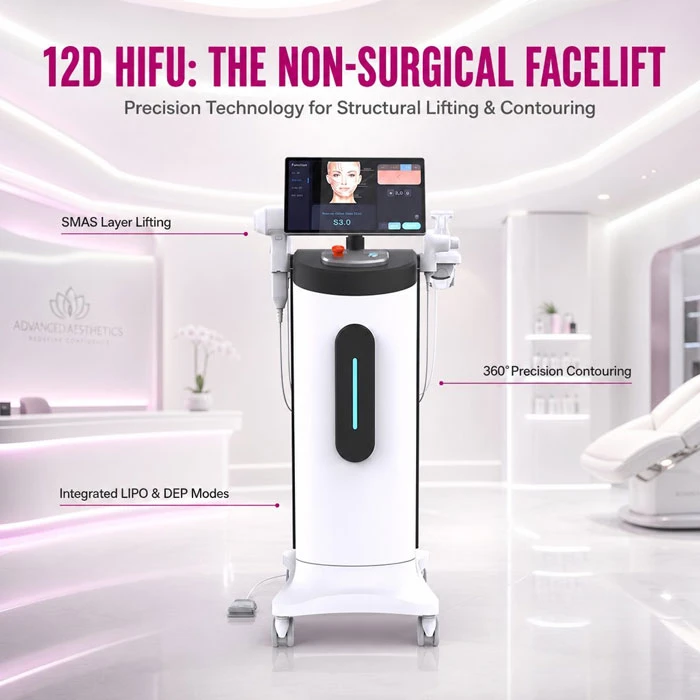
Modern HIFU systems may feature different treatment cartridges, adjustable energy settings, touchscreen controls, and treatment modes designed for specific areas. Some systems offer multiple transducers for facial and body applications, although the intended uses and evidence vary by model.
When selecting a HIFU machine, professional buyers should consider more than the number of treatment lines or cartridges. Important factors include:
Energy consistency: Reliable delivery of the intended energy is essential for controlled treatment.
Treatment depth: Available transducers should match the intended applications and the manufacturer's specifications.
Safety features: Clear operating instructions, appropriate controls, and training support are important.
Operator training: Staff should understand facial anatomy, contraindications, treatment planning, and complication management.
After-sales support: Technical assistance, maintenance, replacement parts, and operator training can affect long-term equipment use.
Regulatory compliance: Verify the device's applicable registrations, clearances, and permitted indications in the target market.
A supplier should provide accurate technical specifications and avoid promising guaranteed lifting, permanent results, or identical outcomes for every client.