Non-ablative Fractional Laser Principle
Nov 21, 2026
Non-ablative fractional laser technology has become an important option in skin rejuvenation because it can improve skin texture, fine lines, acne scars, and uneven pigmentation without removing the outer skin layer. Instead of creating a continuous wound across the treatment area, the laser delivers energy into microscopic zones of the skin, leaving surrounding tissue intact.
1. What Is the Principle of Non-Ablative Fractional Laser?
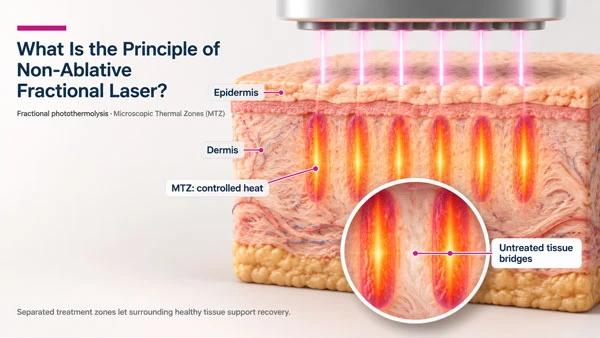
Non-ablative fractional laser works through a process called fractional photothermolysis. The laser energy is delivered in a pattern of tiny, separated treatment points rather than covering the entire skin surface at once.
Each laser point creates a microscopic thermal zone (MTZ). Within these zones, controlled heat stimulates a wound-healing response and collagen remodeling. The surrounding untreated tissue remains relatively intact and helps support the skin's natural recovery process.
This is the key difference between fractional and traditional full-field laser treatment: the skin is treated in small, separated areas, allowing recovery to occur between the treatment zones.
2. How Does the Laser Energy Work?
The treatment process can be understood in three stages.
Stage 1: Laser energy penetrates the skin
The laser emits a specific wavelength that is absorbed by water within the skin tissue. The absorbed energy is converted into heat.
Depending on the wavelength, energy settings, pulse duration, and treatment parameters, the thermal effect can reach different depths and affect different skin structures.
Stage 2: Microscopic thermal zones are created
The laser produces small, controlled thermal columns within the skin. These zones stimulate a localized tissue response without intentionally removing the entire epidermal surface.
The surrounding untreated skin helps support repair, which is one reason non-ablative fractional treatments generally have less downtime than ablative resurfacing procedures.
Stage 3: Skin repair and collagen remodeling begin
Following treatment, the body initiates a repair response. Skin cells gradually replace or remove damaged tissue, while fibroblasts participate in the production and remodeling of collagen and other components of the dermal matrix.
Over the following weeks, this remodeling process may improve skin texture, firmness, fine lines, and the appearance of certain scars. Results are gradual rather than immediate.
3. What Is the Difference Between 1550nm and 1927nm?
Two common wavelengths in non-ablative fractional laser technology are 1550nm and 1927nm. Although both interact with water in skin tissue, their absorption characteristics and treatment profiles differ.
Commonly used for skin texture improvement, acne scars, fine lines, and dermal remodeling. Its treatment profile is often selected when the target is deeper dermal tissue.
More strongly absorbed by water than 1550nm in typical tissue interactions, producing a more superficial treatment profile. It is often used for pigmentation, uneven skin tone, photodamage, and superficial skin texture concerns.
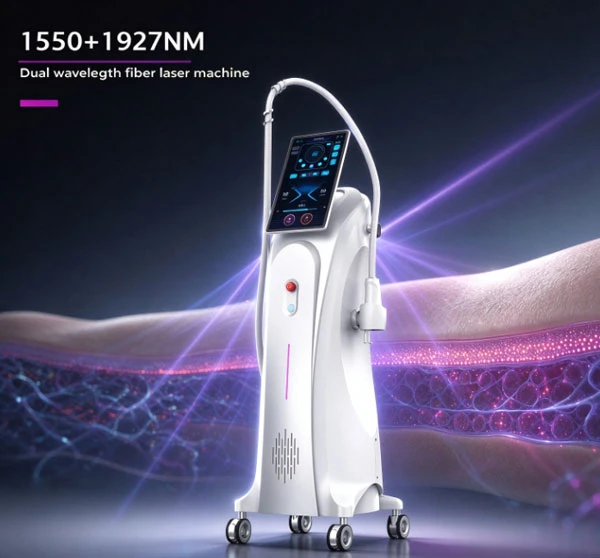
A dual-wavelength system combining 1550nm and 1927nm can give practitioners greater flexibility to address both superficial and deeper skin concerns. However, treatment selection and settings should be based on the patient's skin condition, skin type, and clinical assessment.
4. Non-Ablative vs. Ablative Fractional Laser
Both technologies use fractional treatment patterns, but they differ in how they interact with the skin.
| Feature | Non-Ablative Fractional Laser | Ablative Fractional Laser |
|---|---|---|
| Main action | Thermal stimulation | Tissue vaporization and thermal stimulation |
| Skin surface | Generally preserved | Micro-ablated treatment zones |
| Treatment depth | Depends on wavelength and settings | Depends on wavelength and settings |
| Recovery | Usually shorter | Usually longer |
| Skin peeling | Mild flaking may occur | More noticeable healing and crusting may occur |
| Common applications | Texture, pigmentation, fine lines, scars | Deeper resurfacing, scars, wrinkles |
| Treatment approach | Often a series of sessions | May require fewer sessions depending on indication |
Non-ablative treatment is often selected when patients prefer gradual improvement and shorter recovery. Ablative fractional treatment may be considered when more intensive resurfacing is needed, although the risk profile and recovery requirements are different.
Neither technology is universally better. The appropriate choice depends on the treatment indication, patient characteristics, clinical expertise, and device parameters.
5. What Skin Conditions Can It Treat?
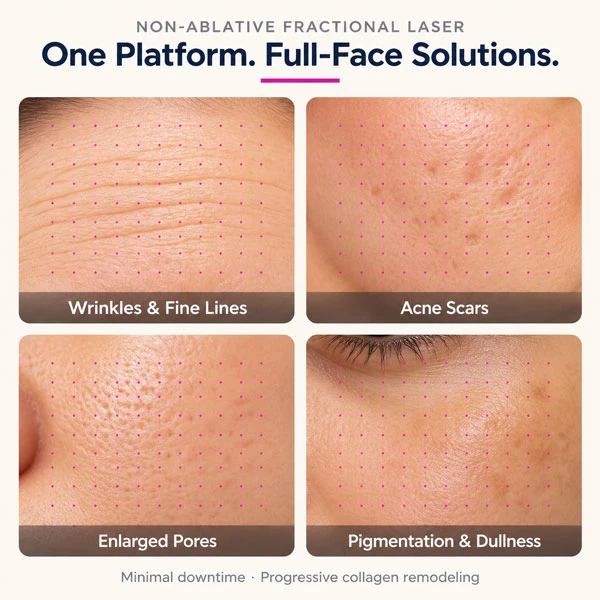
Non-ablative fractional lasers are commonly used in aesthetic and dermatological settings for:
Acne scars and certain other scars
Enlarged pores and rough skin texture
Fine lines and early signs of skin aging
Uneven pigmentation and photodamage
Dull or uneven skin tone
Skin texture improvement
Selected stretch marks
Different wavelengths and treatment settings may be used for different indications. Results vary from patient to patient, and some conditions require multiple sessions or combination treatments.
6. What Happens After Treatment?
After a non-ablative fractional laser procedure, patients may experience temporary redness, warmth, swelling, or a rough feeling in the treated area. Mild flaking or tiny darkened spots may also appear during the recovery period.
Because the treatment creates microscopic zones of thermal injury, skin repair continues after the visible redness has subsided. Collagen remodeling takes place over time, so improvements in texture and firmness may become more noticeable over several weeks or months.
Proper post-treatment care is important. Patients should follow their practitioner's instructions regarding gentle cleansing, moisturizing, sun protection, and avoiding irritating skincare products during recovery.
7. Why Are Non-Ablative Fractional Lasers Popular in Aesthetic Clinics?
For aesthetic clinics and medical spas, non-ablative fractional lasers offer a treatment option between basic facial treatments and more intensive resurfacing procedures.
Their appeal includes:
A wide range of skin rejuvenation applications
Gradual improvement with a series of treatments
Generally shorter recovery compared with ablative resurfacing
Adjustable treatment parameters
Options for different skin concerns using different wavelengths
Potential to add skin rejuvenation services to an existing treatment portfolio
However, clinic operators should evaluate wavelength, energy control, treatment density, pulse parameters, cooling, safety systems, training, and service support when selecting equipment. A machine's wavelength alone does not determine its clinical performance.
8. Non-Ablative Fractional Laser Technology from NewAngie
NewAngie provides professional aesthetic laser equipment solutions for clinics, medspas, beauty centers, and distributors. Dual-wavelength 1550nm and 1927nm fractional laser technology offers equipment buyers an option for developing skin rejuvenation services targeting skin texture, pigmentation, and aging-related concerns.
For distributors and clinic owners evaluating fractional laser equipment, product selection should consider not only the wavelength configuration but also operating stability, treatment flexibility, operator training, warranty, technical support, and customization requirements.
NewAngie supports OEM and ODM services, including product branding, appearance customization, and packaging solutions for professional equipment partners.