

How Do 532nm, 1064nm And 755nm Work Together To Target Stubborn Pigmentation?
Aug 30, 2026
Some pigment appears close to the skin surface, while other pigment can be located deeper within the dermis. Different pigments may also respond differently to laser wavelengths. This is why choosing a laser based on a single wavelength may not always provide the flexibility that modern aesthetic clinics need.
The combination of 532nm, 755nm and 1064nm gives a picosecond laser platform three different wavelength options for approaching pigment at different depths and with different optical characteristics.
Rather than simply "stronger laser = better results," the key concept is wavelength selection + pulse duration + energy control + treatment strategy.
For professional clinics, this multi-wavelength approach can make the NewAngie Picosecond Laser a more versatile platform for managing difficult pigmentation cases.
Why Is Stubborn Pigmentation Difficult to Treat?
Pigmentation can be located at different levels of the skin.
Superficial pigmentation is generally closer to the epidermis, while dermal pigmentation can extend deeper into the skin. Melasma and post-inflammatory pigmentation can also behave differently from clearly defined lesions such as freckles or solar lentigines.
This creates a major challenge:
The same wavelength and treatment approach may not be ideal for every pigment problem.
Clinical studies have evaluated 532nm, 755nm and 1064nm picosecond or Q-switched laser systems for different pigmentary conditions, demonstrating why wavelength selection is an important part of treatment planning.
This is where a three-wavelength platform becomes valuable.

532nm: A Strong Option for More Superficial Pigment
Among the three wavelengths, 532nm has relatively strong absorption by melanin and is commonly associated with more superficial pigment targets.
It can be considered for certain epidermal pigmentation concerns, depending on the diagnosis, skin type and treatment parameters.
In clinical research, 532nm Q-switched laser has been used for epidermal hyperpigmented lesions, while 1064nm has been used for deeper dermal lesions.
This makes 532nm particularly interesting when the target is relatively close to the surface.
Typical applications may include:
Freckles
Certain superficial pigmented lesions
Some sun-related pigmentation
Selected epidermal pigment concerns
However, 532nm should not simply be viewed as the "best wavelength for pigmentation."
Its stronger interaction with superficial melanin also means that treatment must be carefully controlled, particularly for patients with darker skin types or a higher risk of post-inflammatory hyperpigmentation.
The objective is not to deliver maximum energy.
The objective is to deliver appropriate energy to the intended target while minimizing unnecessary thermal injury.
755nm: A Middle-Ground Option for Challenging Pigment
The 755nm alexandrite wavelength occupies an interesting position between 532nm and 1064nm.
It has strong affinity for melanin and can penetrate deeper than 532nm, making it useful for certain pigmentary conditions where a superficial wavelength may not be the optimal choice.
Research has evaluated 755nm picosecond lasers for freckles and dermal pigmentary conditions, including studies involving Asian skin types.
One retrospective study involving Fitzpatrick III–IV Asian patients reported improvement in dermal pigmentary conditions treated with a 755nm picosecond laser, with no permanent hyper- or hypopigmentation reported during the study follow-up.
This helps explain why 755nm can be valuable in a multi-wavelength platform.
It provides another option when the practitioner needs to balance:
Pigment absorption + treatment depth + controlled energy delivery.
For clinics treating a wide range of pigmentation concerns, this flexibility can be commercially and clinically useful.
1064nm: Reaching Deeper Pigment With Greater Selectivity
The 1064nm wavelength is particularly important in a multi-wavelength pigment platform because its longer wavelength generally penetrates deeper into tissue than 532nm.
It is widely associated with treatment of deeper pigmentary targets and has been extensively studied in pigmentary disorders.
For example, clinical research has used 1064nm for dermal hyperpigmentation, while 532nm was used for epidermal lesions.
1064nm is also an important wavelength in the treatment of melasma.
A systematic review and meta-analysis of picosecond laser treatment for melasma found that the 1064nm subgroup significantly reduced MASI/mMASI scores without significant side effects in the analyzed studies, although the authors emphasized that treatment outcomes across studies were heterogeneous.
This is one reason 1064nm remains an important wavelength for professional pigmentation treatment.
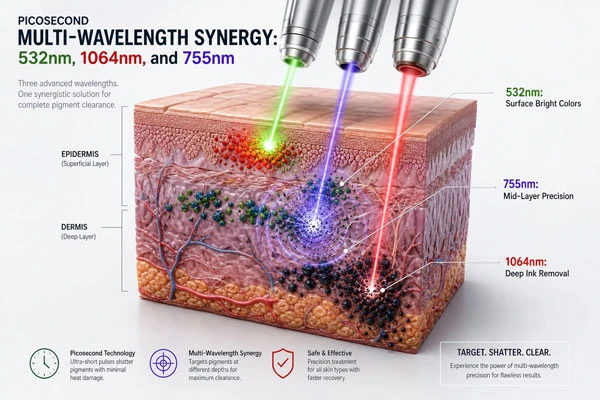
Three Wavelengths, Three Treatment Strategies
The real advantage is not that one wavelength is universally superior.
It is that the three wavelengths allow practitioners to select a more appropriate option according to the type, depth and clinical characteristics of the pigment.
| Wavelength | General Positioning | Potential Pigment Targets |
|---|---|---|
| 532nm | More superficial | Certain epidermal pigmentation |
| 755nm | Intermediate/deeper melanin targeting | Selected freckles and dermal pigment |
| 1064nm | Deeper penetration | Dermal pigment and selected melasma protocols |
This does not mean that every pigment condition should automatically be treated with all three wavelengths.
Instead:
Three wavelengths = three options.
The practitioner can select the appropriate wavelength rather than forcing every patient into the same treatment protocol.

Why Picosecond Pulse Duration Matters
Wavelength is only half of the equation.
The other important factor is pulse duration.
Picosecond lasers deliver extremely short pulses. Rather than relying primarily on prolonged heating, the ultra-short pulse can generate strong photomechanical/photoacoustic effects that help fragment pigment particles.
A recent review describes picosecond lasers as relying more on photoacoustic destruction than conventional photothermal injury and discusses the use of 532nm, 755nm and 1064nm wavelengths for pigmentary lesions.
This distinction is important.
The goal is not simply to heat pigment until the surrounding tissue becomes excessively hot.
Instead, the technology aims to create a strong interaction with the target pigment while limiting unnecessary thermal exposure.
That is one of the fundamental reasons picosecond technology has become attractive for modern pigment treatments.
The "Layer-by-Layer" Concept
When people ask how a three-wavelength picosecond laser can "remove stubborn pigmentation," the answer is not that the machine literally scans the skin layer by layer with all three wavelengths simultaneously.
A better way to understand the concept is:
Different wavelengths provide different optical tools for different pigment targets.
Imagine pigmentation as existing at different depths:
Surface Level
A superficial pigment target may respond better to a wavelength such as 532nm, depending on the lesion and patient.
Intermediate Level
Some pigment concerns may be approached with 755nm when its optical characteristics are appropriate.
Deeper Level
For deeper dermal pigment, 1064nm provides greater penetration and is widely used in pigment treatment protocols.
This creates a more flexible treatment strategy than relying on one wavelength for every case.
Why "Stubborn Pigment" May Need a Different Strategy
Some patients have already undergone multiple cosmetic treatments.
They may report:
Pigment that has only partially faded
Pigmentation that repeatedly returns
Uneven treatment response
Mixed superficial and deeper pigmentation
Skin that has become more sensitive after previous procedures
In these cases, simply increasing laser energy is not necessarily the answer.
A better strategy is to reconsider:
What type of pigment is present?
Where is the pigment located?
Which wavelength is most appropriate?
What pulse duration and energy are suitable?
How much treatment can the patient's skin safely tolerate?
This is where a multi-wavelength system can offer greater flexibility.
Three Wavelengths Do Not Mean "Three Times the Power"
This is an important distinction for professional marketing.
A three-wavelength system should not be promoted as simply having "more power."
Its value comes from better wavelength selection.
For example:
A superficial pigment problem does not automatically require 1064nm.
A deeper pigment problem does not automatically require 532nm.
And melasma should not automatically be treated by aggressively targeting every visible brown area.
The treatment objective should always be:
Match the wavelength to the target.
This is also why professional assessment is essential.
Why 1064nm Is Particularly Interesting for Melasma
Melasma deserves special attention because it is not simply a conventional pigment spot.
It is a chronic and recurrent disorder influenced by multiple factors, including UV exposure, hormonal influences and inflammatory pathways.
Laser treatment therefore needs a more conservative and individualized approach.
The evidence for picosecond laser in melasma is promising but not uniform. A systematic review found significant improvement in MASI/mMASI overall, while also noting substantial heterogeneity between studies. The review found stronger evidence for 1064nm than for 755nm in its subgroup analysis.
Therefore, a responsible NewAngie marketing message should not promise:
"One treatment permanently removes melasma."
A more accurate positioning is:
"1064nm picosecond technology provides a professional option for selected melasma treatment protocols."
This is both more credible and more consistent with current clinical evidence.
Why Multi-Wavelength Technology Matters to Clinics
From a clinic business perspective, a three-wavelength platform provides another major advantage:
One device can address a broader range of treatment needs.
Instead of maintaining separate platforms for every pigment category, clinics can potentially build a wider treatment menu around one professional system.
This can support services such as:
Superficial pigmentation management
Freckle treatments
Selected dermal pigmentation treatments
Tattoo-related pigment applications
Skin rejuvenation protocols
Selected melasma protocols
The actual indications depend on the device configuration, practitioner qualifications and local regulations.
For clinic owners, however, the underlying business logic is straightforward:
More wavelength options → more treatment flexibility → broader service portfolio.
NewAngie Three-Wavelength Picosecond Laser: Precision Through Choice
The strongest feature of a 532nm/755nm/1064nm NewAngie Picosecond Laser is not simply the number of wavelengths.
It is the ability to choose between different wavelength characteristics according to the treatment objective.
532nm provides an option for more superficial pigment targets.
755nm provides strong melanin targeting with greater penetration than 532nm.
1064nm provides deeper penetration and is particularly important for dermal pigment and selected melasma protocols.
Combined with picosecond pulse technology, these wavelengths create a flexible platform for professional aesthetic clinics.
The Future of Pigmentation Treatment Is Not "More Energy"
The evolution of laser pigmentation treatment is moving away from a simple philosophy:
"Use more energy to remove more pigment."
Modern treatment is increasingly about:
Target selection → wavelength selection → pulse control → energy management → skin response → individualized treatment.
This is especially important when treating patients with higher pigmentation risk.
The objective is not to make the laser treatment as aggressive as possible.
The objective is to make it as targeted and controlled as possible.
That is the real value of a multi-wavelength picosecond platform.
Persistent pigmentation requires more than a powerful laser.
It requires the right wavelength for the right target.
With 532nm, 755nm and 1064nm, the NewAngie Picosecond Laser provides three different wavelength options for addressing pigment at different depths and with different optical characteristics.
532nm can provide an option for more superficial pigment.
755nm offers another approach for melanin-rich and selected dermal pigment targets.
1064nm provides deeper penetration and has an established role in professional pigment treatment, including selected melasma protocols.
Combined with ultra-short picosecond pulses, the three-wavelength platform allows clinics to move toward a more individualized treatment philosophy:
Not simply stronger.
Not simply faster.
But more targeted.
For modern aesthetic clinics, that is the real meaning of multi-wavelength picosecond technology.


